Georgia Okeeffe Is a Major Innovator in Abstraction in Early Modern Art
Georgia O'Keeffe, likewise known equally the mother of American modernism, played an extremely important part in the evolution of American gimmicky art and its human relationship with European movements of the early twentieth century. O'Keeffe has produced a big body of work over 7 decades. She was ever putting a lot of efforts into combining her talent with her superior skills in club to capture the emotions and power of objects she was painting. Her principal goal was to abstract the natural world so that it becomes even more highly-seasoned visually. Fifty-fifty though O'Keeffe didn't follow any artistic movements, an eminent photographer Alfred Stieglitz recognized her every bit the first female American modernist painter and her paintings of flowers and desolate landscapes have get a part of the American artistic treasure.
Early Life and Education
Georgia O'Keeffe was born in Wisconsin in 1887. She came from a very large family unit – she was the second of vii children. Considering of her early brandish of visual talents, O'Keeffe was encouraged to study fine art – her mother was very enthusiastic about her inborn talent. The artist had the opportunity to accept watercolor lessons with one of the local artists in Wisconsin, called Sara Mann. O'Keeffe was very fortunate because she came from a family who cared about female education, which wasn't so common around the finish of 19th century. She initially attended the Schoolhouse of the Art Constitute of Chicago and later on, in 1907, she moved to New York City where she connected her education. In NYC, she took classes at the Art Students League, while her mentor was William Merritt Chase. Already in her school days, O'Keeffe stood apart from other children for her great skills. She won an important cash prize for 1 of her yet lifes and thanks to this prize she was able to attend a summer school in Lake George. During her years spent in NYC, O'Keeffe was frequently attending exhibitions at Gallery 291, whose owner was a photographer Alfred Stieglitz, who after became her partner and husband. Thanks to various shows held at Gallery 291, O'Keeffe could see the works of eminent European artists, for case, Auguste Rodin and Henri Matisse. In 1908, O'Keeffe has abandoned her own artistic exploration for 4 years because she got a job every bit a commercial artist. However, in 1912 she decided to focus again on her personal projects. She took some cartoon classes to refresh her knowledge and her teacher at the time, called Alon Bement, was a peachy influence. His style was based on the work of Arthur Wesley Dow. In 1915, while she was working as a lecturer at Columbia Higher in South Carolina, O'Keeffe started to do something entirely new – she wanted to learn more about Dow's theory of self-exploration by the means of art. Inspired past this theory, O'Keefe started focusing on natural forms, similar flowers, clouds, and waves and made her first serial of charcoal drawings which simplify and abstract organic shapes into expressive lines. Eventually, she has shown these drawings to Alfred Stieglitz in1916. The photographer was quite impressed and he was already convinced that O'Keeffe future career will exist vivid and successful.
O'Keeffe was very fortunate because she came from a family unit who cared about female education
Life in New York
After Stieglitz has recognized O'Keeffe potential, he started a correspondence with her. He has even exhibited some of her charcoals at his gallery without letting O'Keeffe know about that. He but sent her photographs of her exhibited drawings afterward and this marked the beginning of their collaboration. Even though O'Keeffe has connected to work in Due south Caroline for a while, she eventually decided to return to New York in 1917. The same year, Stieglitz has organized her start solo exhibition at Gallery 291. Around the same time, O'Keeffe and Stieglitz got engaged in the beloved affair that lasted for many years. In 1918, Stieglitz began to financially back up O'Keeffe, and then that they could live together and work in New York. O'Keeffe has left her didactics position and became focused on making her own, unique art. Later on Stieglitz has divorced his showtime married woman, he married the artist in 1924. The 1920s were exciting and decorated years for O'Keeffe considering she met many artists from Stieglitz's circle, such as Arthur Pigeon, John Marin, and Paul Strand. She appreciated very much the shut-up photography of Strand, which has influenced her own creative indicate of view. During the 20s, O'Keeffe'southward was painting mostly close-ups of natural forms using watercolors and oil paint. Besides flowers, she was likewise depicting architectural structures. Around 1925, O'Keeffe was already an established creative person and her pieces were getting sold at considerable prices.
In 1918, Stieglitz began to financially support O'Keeffe, and so that they could alive together and work in New York
Fascination with New Mexico
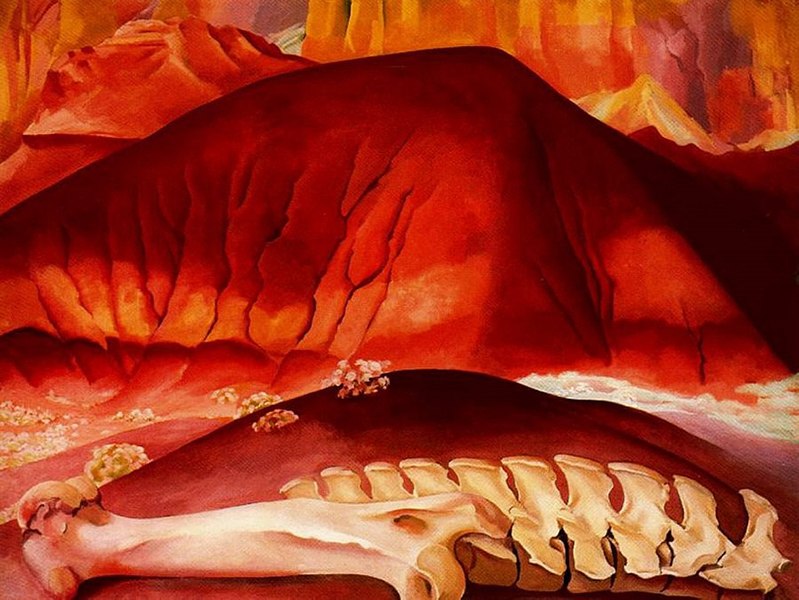
Information technology is known that a lot of O'Keeffe'due south pieces non related to flowers correspond barren, desert landscapes of New Mexico. The artist'due south fascination with the landscape of southwestern United States started in 1929. That twelvemonth, O'Keeffe has visited the ranch of eminent arts patron, Mabel Dodge Luhan, located in Taos in New Mexico. The artist has instantly fallen in love with the amazing local landscape, consisting of harsh, arid land. For the adjacent 20 years, the artist kept coming back to New United mexican states to paint. Her pieces dedicated to these landscapes perfectly captured the mesmerizing beauty of the desert, its wide open up skies, as well as specific objects such as southern architectural structures and animal basic and skulls. The eventually concluded upwardly ownership two houses in New Mexico, because she didn't desire to be just someone's guests – she wanted to truly belong to this environs. In the 1930s and 1940s, O'Keeffe grew fifty-fifty more popular and recognized, later on ii important retrospectives featuring her work were organized. The first retrospective was held in 1943 at the Art Establish of Chicago, while the second 1 was in 1946 at the Museum of Modern Art in New York. This prove in MOMA was a keen success because it was the starting time retrospective of work by a woman organized by the eminent museum. In 1949, O'Keeffe has decided to move permanently to New United mexican states, since her partner Stieglitz has died and she was feeling heartbroken. In the 1950s, she was traveling a lot and she has created a series of paintings representing various architectural forms. Fifty-fifty though her fame was waning in the 1950s and 1960s, another retrospective of her work was held by the famous Whitney Museum in 1970. Around the same time, O'Keeffe started having bug with her eyesight and information technology getting hard for her to create art, but she persisted in her passion. She continued using watercolors and pencils until she had completely lost her central vision when she was 84. In it quite interesting that her final drawings resemble her early charcoal works. O'Keeffe has died in 1986 in Santa Atomic number 26 when she was 98 years old.
The creative person's fascination with the landscape of southwestern United States started in 1929
Main Topics in O'Keeffe's Fine art
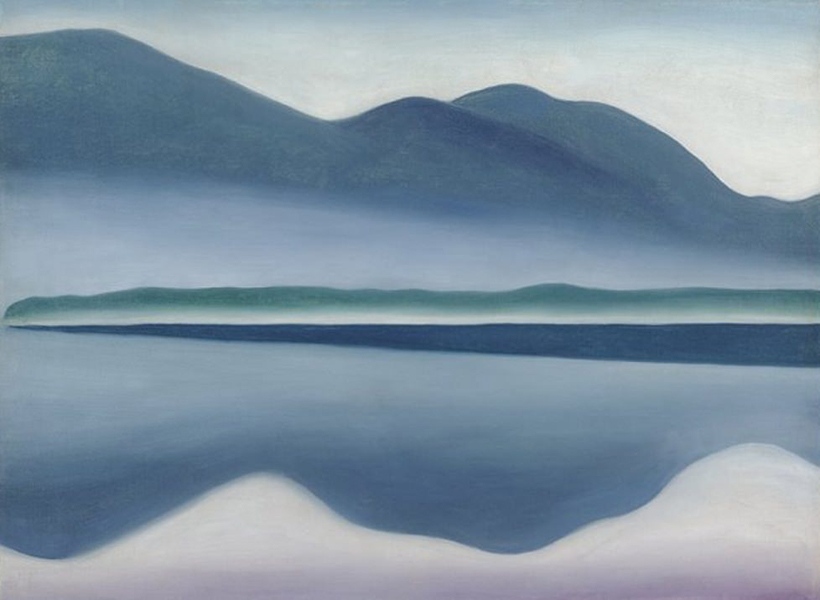
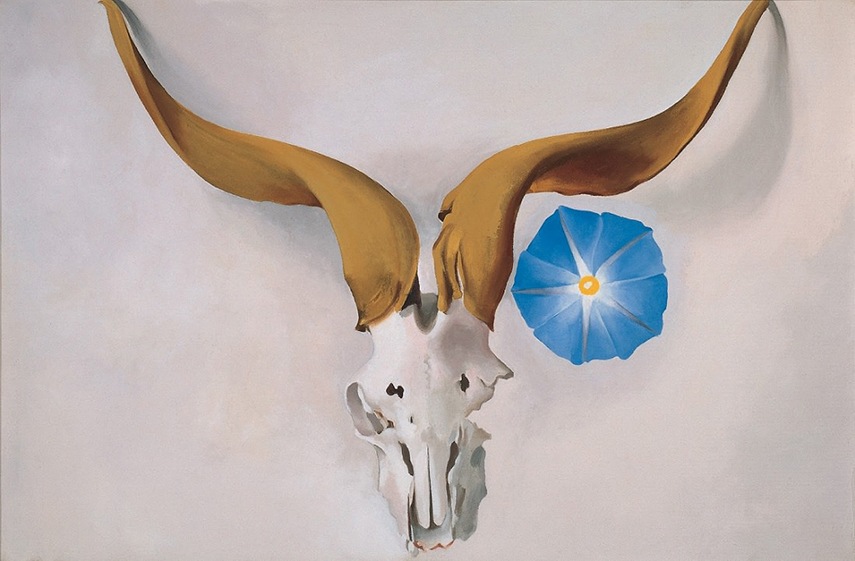
Even though O'Keeffe's way is quite original, she incorporated the techniques she has learned from other artists into her work. Nigh notably, she was influenced by Paul Strand's tight cropping used in photographs. O'Keeffe was i of the kickoff artists who started using this close-up arroyo which was mainly reserved for photography. It is also quite interesting and innovative that her piece of work is very detailed yet clearly abstract. O'Keeffe wasn't keen on following any artistic movement, but what information technology common throughout her oeuvre is her trend to abstruse motifs from nature. She always worked in series, combining unique abstraction with realism in order to produce pieces which celebrate the beauty of elementary natural forms. From the 1940s until the 1960s, O'Keeffe's pieces were conspicuously non belonging to the mainstream movements in arts. Her works were decisively representative, while the other artists of the same generation were exploring generally non-representative realms. When it comes to the main motifs of her work, these are certainly flowers, animal basic, and various landscapes. Most of her landscapes are representing scenes from New Mexico, but a couple of them are also defended to lakes, such every bit Lake George where she used to get to attend summer schoolhouse classes. It is also clear from her works that she was fascinated with animal skulls. She was painting various skulls isolated on the canvas, outside of their usual environment. O'Keeffe was using mainly the moo-cow'due south skull and red, white, and blueish background behind them, to underline the correlation between the American landscape and the national identity.
When it comes to the chief motifs of 0'Keeffe's work, these are flowers, animal basic, and landscapes
Lack of Hidden Symbolism in Bloom Painting
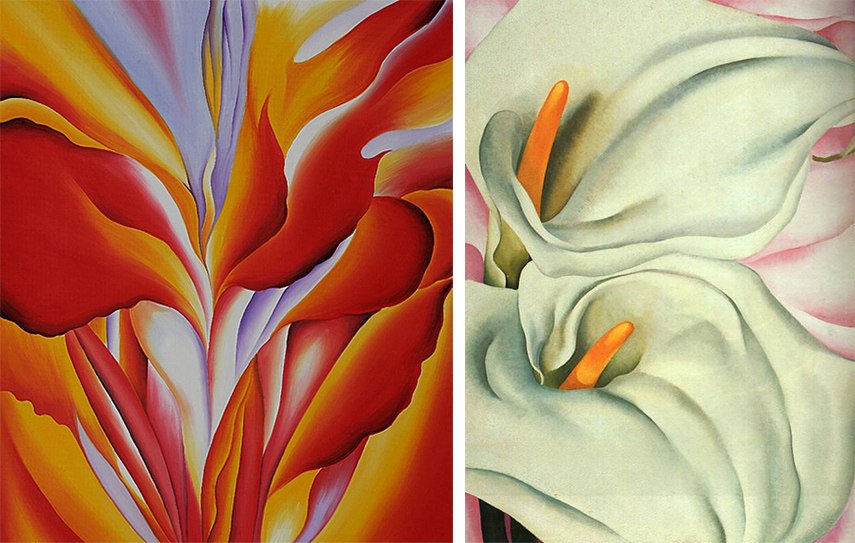
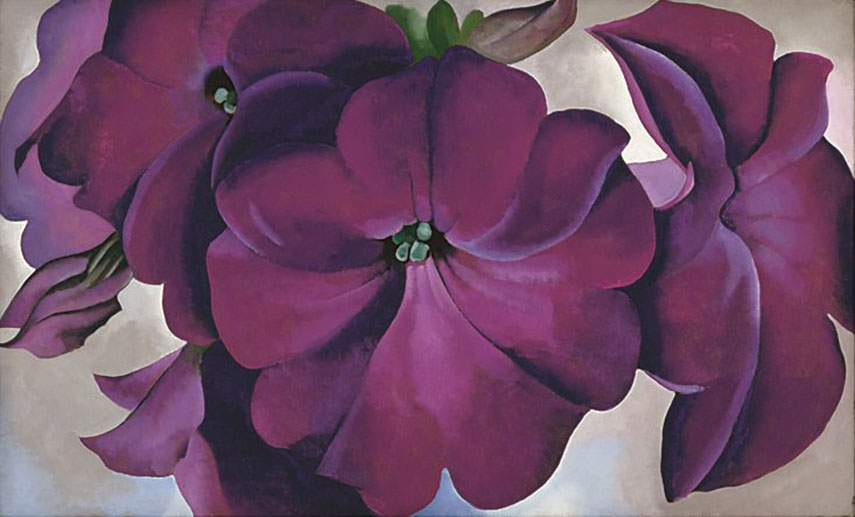
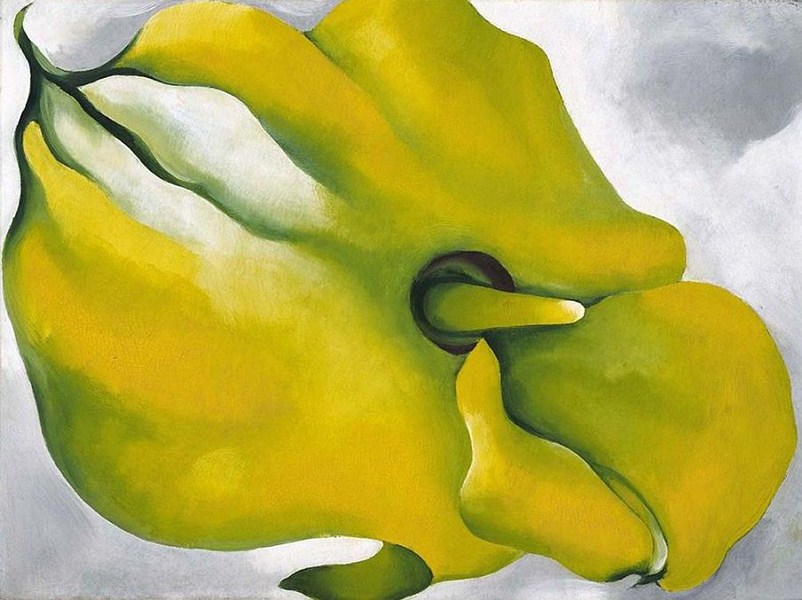
No affair the variety of her works, O'Keeffe is still all-time known for her bloom paintings. They are the topic that has marked her entire oeuvre . O'Keeffe's paintings magnify the delicate form of flower and focus on its shape and colour. Her depiction of floral motifs has oft received interpretations that the artist has firmly disagreed with. She had a constant struggle with the feminist fine art critics, who considered her paintings equally metaphors or symbols for female ballocks. O'Keeffe has claimed many times that there is no hidden symbolism in her work and that she is simply interested in the very essence of flowers. In fact, the anatomy of many species that she depicted, similar petunia, is very complex and certainly doesn't resemble female anatomy. Based on this, the Tate Mod's managing director of exhibitions claimed that one of the reasons he wanted to organize the retrospective of O'Keeffe work is to show to the audience that there are multiple readings of her work and that things aren't that simple and straightforward. Many of the white male artists beyond the 20th century have the privilege of being read on multiple levels, while others – exist they women or artists from other parts of the world – tend to be reduced to one conservative reading, he said.
The artist had a constant struggle with the feminist artists, who viewed her paintings as a sign or symbols for female genitalia and her ideas as tools of latent feminism
Georgia O'Keeffe's Legacy
Georgia O'Keeffe has spent most 70 years in making a powerful art which speeded up the development of modernism in America. She was also very agile socially, equally an important member of the pop Stieglitz Circle. It is interesting that she was a pioneering female person artist who had a potent influence on the feminist movement, even though she disliked their estimation of her work. O'Keeffe was an incredibly prolific creator – she has made more than 2000 works and she was active even around the end of her life, while she was suffering from macular degeneration. O'Keeffee has won a number of important prizes and medals for her work - in 1962, she was elected as the fiftieth member of the American Academy of Arts and Letters, while in 1966, she became a fellow of the American Academy of Arts and Sciences. Finally, in 1985, she was awarded the prestigious National Medal of Arts. The Georgia O'Keeffe museum that was raised in Santa Fe is actually the first artspace in the United States dedicated solely to a woman. This institution continuously sponsors fellowships for scholars and artists and at the same fourth dimension, it represents a sanctuary of O'Keeffe's splendid pieces.
Georgia O'Keeffe has spent nearly seventy years in making art that speeded upward the evolution of modernism
Colors and Shapes Instead of Words
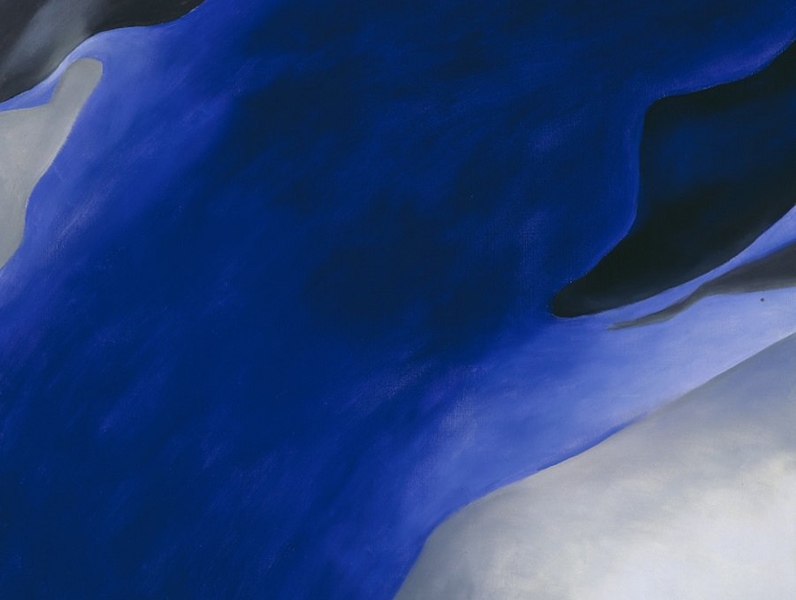
I found I could say things with color and shapes that I couldn't say any other way - things I had no words for, said O'Keeffe about her life philosophy and her fine art. Even though the creative person is still all-time known for her particular style featured in her works sold at the highest price, her body of work is in fact very varied and rich and it requires a lot of exploration. However, no matter the item topics in her pieces, O'Keeffe was always truthful to her own vision and imagination. She has built a beautiful world of paintings that lingers between the verse of abstraction and the straightforwardness of representation. Nowadays, she is nevertheless considered one of the well-nigh innovative artists of the twentieth century.
Georgia O'Keeffe lived and worked between New York and New United mexican states.
Featured image: Georgia O'Keeffe'south Portrait, 1918 - Photo Credits Alfred Stieglitz
All other images via georgiaokeeffe.cyberspace
Source: https://www.widewalls.ch/artists/georgia-okeeffe
0 Response to "Georgia Okeeffe Is a Major Innovator in Abstraction in Early Modern Art"
Postar um comentário