How to Determine Household Income if Two Family Lives in One House
Fiscal eligibility for about categories of Medicaid and the Children'southward Health Insurance Programme (CHIP) is determined using a tax-based measure of income called modified adjusted gross income (MAGI). The MAGI methodology includes rules prescribing who must exist included in a household when determining eligibility. The following Q&A explains MAGI and the rules for determining Medicaid and Chip households under MAGI.
↓ Download PDF
What is MAGI?
MAGI is a methodology used to decide income for the purposes of Medicaid or CHIP eligibility. It is based on revenue enhancement definitions of income and household. MAGI rules for determining what income to count when determining Medicaid, Fleck, and premium tax credit eligibility are more often than not aligned. The rules determining who is in a household and whose income to count, however, can vary significantly. Also, under MAGI rules, an individual or family's assets practise non count in determining eligibility. (For more than data on what income counts under MAGI rules, see Key Facts: Income Definitions for Marketplace and Medicaid Coverage.)
To whom exercise the MAGI rules apply?
All states must use the MAGI rules regardless of the decision to expand Medicaid. However, MAGI rules use but to certain categories of Medicaid eligibility. These include parents and caregiver relatives, children, pregnant women, and the adult expansion group. States' previous rules for determining income and households go on to apply to the elderly, disabled, and children in foster intendance.
How do Medicaid and premium taxation credit household rules differ?
Medicaid and Chip households are adamant based on a person's family and tax relationships too as their living arrangements. How people file taxes and who is in their revenue enhancement unit doesn't always determine who is in their Medicaid household, merely it determines which Medicaid household rules utilise in defining the household. Premium tax credit household rules, on the other mitt, are based purely on tax relationships.
The most important difference betwixt Medicaid and premium taxation credit households is that for Medicaid, household size and composition are determined separately for each member of the household, simply for the premium tax credit, members of a tax unit are e'er treated equally a household. This means that for Medicaid, household size may differ for family members even when they are in the same revenue enhancement filing household. Thus, it is possible that for Medicaid, a family of iii filing its taxes together may have 2 members with a household size of three and the third member of the family may be a household of one. For the premium taxation credit, each member of a household that files its taxes together will have the aforementioned household size. (For more than information on determining household size for the premium tax credit, see Cardinal Facts: Determining Household Size for the Premium Tax Credit.)
Another important difference is Medicaid provides states with several options that bear upon how they ascertain households when determining Medicaid eligibility. However, considering the premium taxation credit is a federal benefit, the rules are established at the federal level and are consistent beyond states.
How does Medicaid determine who is in a household?
Medicaid determines an private's household based on their plan to file a taxation return, regardless of whether or not he or she actual files a render at the stop of the year. Medicaid too does not crave people to file a federal income tax render in previous years.
For each individual applying for coverage, Medicaid looks at whether he or she plans to be:
- a tax filer
- a tax dependent
- neither a taxation filer nor a dependent
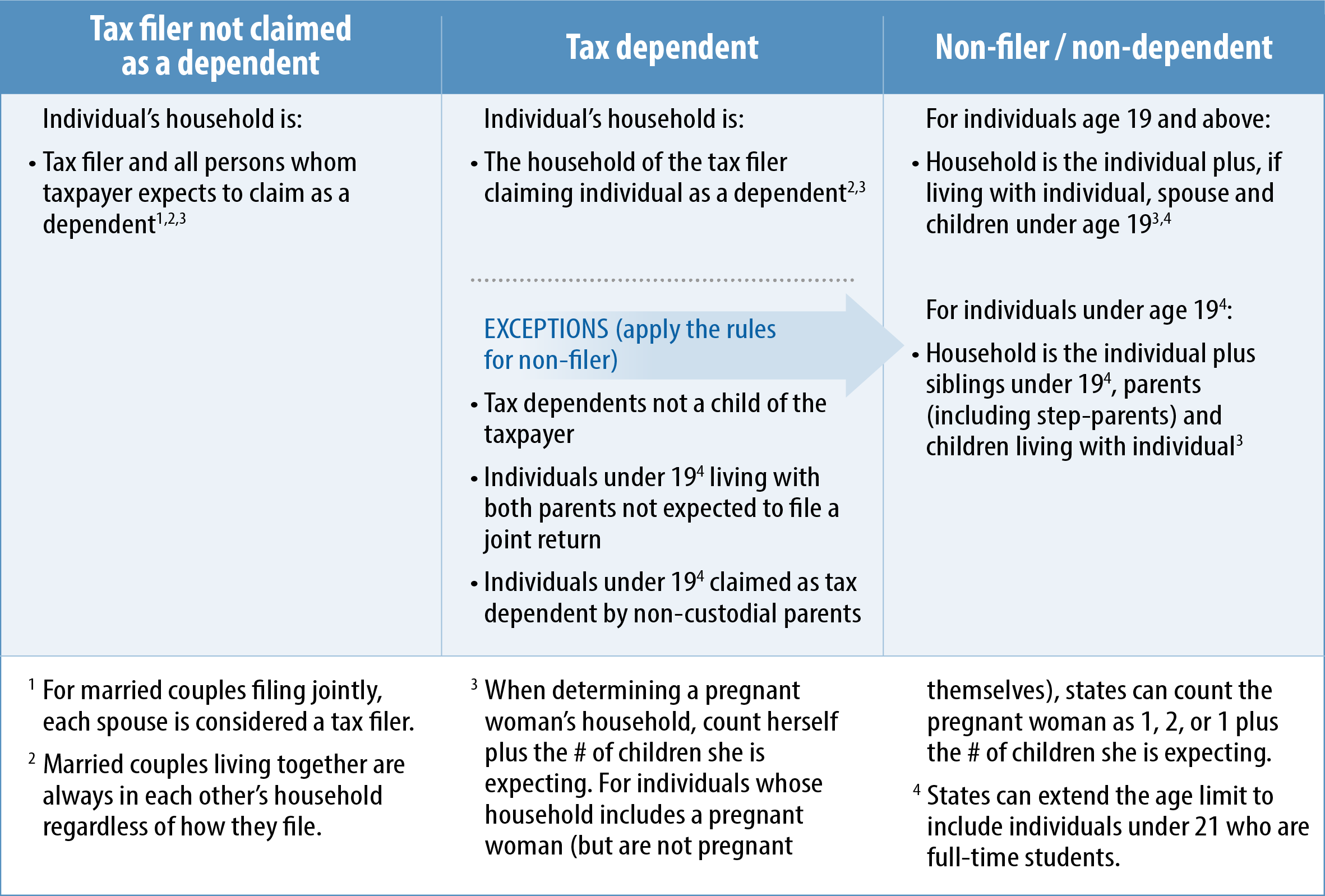
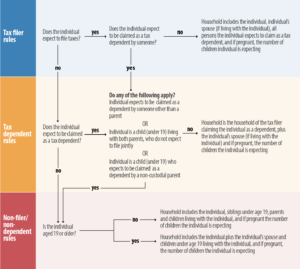
People's intended tax filing status determines which Medicaid household rules utilise in making the household determination. Figure i summarizes the Medicaid household rules and Figure 2 shows how to apply these rules. (For more than information, see Reference Guide: Medicaid Household Rules.)
| FIGURE 1: MAGI Rules for Determining Medicaid and Fleck Households | ||
 | ||
| FIGURE two: How to Decide An Individual's Medicaid Household | ||
 | ||
What are the household rules for a revenue enhancement filer?
For tax filers challenge their own exemption and who tin't be claimed as a taxation dependent, the household includes the taxation filer, the spouse filing jointly, and anybody whom the tax filer claims as a revenue enhancement dependent.
What are the household rules for tax dependents?
For tax dependents, the household is the aforementioned as the revenue enhancement filer claiming the individual equally a tax dependent. Nonetheless, there are three exceptions to this rule, when the rule for non-filers is practical:
- Individuals who expect to be claimed equally a dependent by someone other than a parent;
- Individuals (under 19) living with both parents, whose parents exercise not expect to file a articulation taxation render; and
- Individuals (nether 19) who expect to be claimed as a dependent by a non-custodial parent.
What are the household rules for people who neither file a tax render nor are claimed every bit a tax dependent?
For individuals who neither file a tax return nor are claimed equally a tax dependent, the household rules differ based on whether the individual is an adult or a modest:
- For individuals nineteen years and older, the household includes the individual plus, if living with the individual, his or her spouse and children who are under 19 years erstwhile.
- For individuals under 19 years old, the household includes the individual, plus any siblings under 19 years old, children of the individual and parents who live with the individual.
Are at that place any adjustments to the three rules based on people's tax filing?
In addition to the general rules for determining household size, some rules use in all situations:
- Married couples who live together are ever counted in each other's household regardless of whether they file a joint or separate return.
- Family size adjustments need to be fabricated if the individual is significant. In determining the household of a meaning woman, she is counted equally herself plus the number of children she is expected to deliver.
What are different options that states have for implementing MAGI?
States accept flexibility in how they implement the MAGI rules in two areas. First, in some instances the Medicaid household rules applied may depend on whether an individual is under xix years old or not. Where the rules indicate an age limit, states have the option to extend that historic period limit to 21 if the private is a full-fourth dimension educatee. Second, for individuals whose household includes a pregnant woman (but are not pregnant themselves), states tin can count the pregnant woman as 1, two, or one plus the number of children she is expecting.
Are married couples who file taxes separately considered to be in separate households?
Generally, no. Married couples who live together are always considered to exist in each other'south household regardless of how they file taxes.
However, married couples who don't alive together and who file taxes separately will exist considered as split up households.
How does Medicaid determine the household size of family unit members when the parents live together but are not married?
Equally long every bit both parents file taxes, non-married parents living in the aforementioned household would however use the rule for tax filers to decide each parent's Medicaid household. This means their household includes themselves and anyone claimed as a dependent on their tax return.
Nonetheless, a child under xix living with non-married parents and existence claimed as a tax dependent by one of the parents, would autumn into the non-filer rule. Therefore, the child'south household size for Medicaid would include himself, both parents, and any siblings living with the kid. For example:
- Dan and Jen live together with their 2 children, Drew and Mary. Because they are not married, Dan and Jen must file separate returns. Jen claims Drew and Mary equally tax dependents on her tax render. Dan files equally a unmarried person and doesn't claim whatsoever tax dependents. Tabular array 1 illustrates the household size determination for each fellow member of the family. To decide the household size for Dan and Jen, Medicaid would utilize the taxation filer dominion and include anybody in each of their specific tax household. To decide the household size for Drew and Mary, Medicaid would employ the non-filer dominion because they are children living with both parents who are non expected to file a joint return.
| TABLE 1: Example of Determining Households for Non-Married Parents | |||||||
| Filing Status | Counted in Household | Household Size | Medicaid Rule Applied | ||||
| Dan | Jen | Drew | Mary | ||||
| Dan | Tax filer | X | 1 | Tax filer rule | |||
| Jen | Taxation filer | Ten | X | X | 3 | Tax filer rule | |
| Drew | Taxation dependent | X | X | 10 | X | 4 | Not-filer rule (exception) |
| Mary | Tax dependent | X | X | X | X | 4 | Non-filer rule (exception) |
How does Medicaid determine the household of an adult child who is claimed every bit a tax dependent by his parents?
The household of an individual who is at least nineteen years old and is claimed as a taxation dependent by his parents is e'er the same as the household of the parents challenge him. This is true even if the private was much older, say 35 years old. For instance, under some circumstances parents can claim their child who is 35 years old every bit a qualifying relative on their taxation return. In this scenario, Medicaid would use the tax dependent rule for determining the household of this individual, which means his household would be the aforementioned every bit the household of his parent (the tax filer) challenge him as a dependent. The following examples illustrate how the Medicaid rules would be applied:
- Barry is 29 and is claimed as a tax dependent by his parents. His parents also claim Barry'southward younger blood brother and sister, who are 15 and 17. When determining his household for Medicaid, Barry has the same household as the revenue enhancement filer claiming him every bit a dependent, thus Barry would have a household size of five: himself, both of his parents, and his brother and sis.
- Carla is 28 years and lives with both parents who are married. Yet, her parents file carve up revenue enhancement returns and Carla'southward father claims her equally a dependent on his tax render. Fifty-fifty though Carla'southward parents file separate returns, married people living together are always in the aforementioned household as their spouse. As a result, Carla's father has a household of three: himself, his spouse, and Carla. This means that Carla also has a household of three.
Does the exception to the tax dependent rule for tax dependents who are non a child of the taxpayer merely employ to adult tax dependents?
No. This exception besides applies to minors claimed every bit a tax dependent by someone other than their parent. Anytime an individual — regardless of age — is claimed as a tax dependent past someone other than their parents, the not-filer rules apply in determining that individual's household. For example:
- Leena lives with and is under the guardianship of her aunt. She is v years old and doesn't have whatsoever siblings or parents living with her. Leena's aunt claims her equally a qualifying relative on her taxation render. Leena is a taxation dependent simply she falls under one of the exceptions to the tax dependent rule because she is non the tax dependent of her parents. This means Medicaid will utilise the non-filer rules to make up one's mind her household, and as a result, Leena'southward household consists only of herself.
View all key facts
Source: https://www.healthreformbeyondthebasics.org/key-facts-determining-household-size-for-medicaid-and-chip/
0 Response to "How to Determine Household Income if Two Family Lives in One House"
Postar um comentário